Engineering robots that understand what we mean and move with intent.
Robotics and AI researcher with 3+ years developing learning-based systems for embodied agents — reinforcement learning, imitation learning, and language-guided motion, taken from simulation to real humanoids. First-author at IROS 2024. Currently applying computer-vision and VLM systems to industrial automation at NTS Solutions.
Research Projects
UNIST · AHRI LAB open_in_newRedefining Data Pairing for Motion Retargeting Leveraging a Human Body Prior
Data-driven motion retargeting is bottlenecked by the cost of human–robot pose data and the motion capture behind it. MR.HuBo inverts the pipeline: it samples robot poses straight from the robot's joint configuration space and exploits a human body prior (VPoser, a VAE) both as an inverse-kinematics solver — mapping each robot pose to a candidate human pose — and as a denoising filter that discards the infeasible ones, yielding 2 million clean pairs per robot with no motion capture. That enabled fully-supervised, end-to-end retargeting (a two-stage 6D-rotation network) where prior work was limited to unsupervised learning — scaling across three humanoids of different kinematics (Reachy, Coman, Nao), in real time on the real Reachy from a single RGB camera.
RLHF Semantic Motion Refinement
The core of my M.S. thesis, framed as an alignment problem for embodied agents. A robot can replicate a human's joint configuration exactly and still lose what the motion means: a retargeted "drinking" gesture that never reaches the mouth is kinematically correct but semantically wrong. I added a post-refinement stage where an agent learns per-joint adjustments for four key joints (shoulder, arm, forearm, wrist) via RLHF — a reward model trained on human-preference comparisons, optimized with PPO — recovering the semantic intent that pure kinematic retargeting discards. In a human survey, refined motions were consistently preferred over the un-refined baseline.
Statistical significance confirmed (ANOVA + Tukey HSD)
Aligned with just 4 rounds of human feedback
menu_book Thesis
CLIP-Style Motion–Language Reward Model
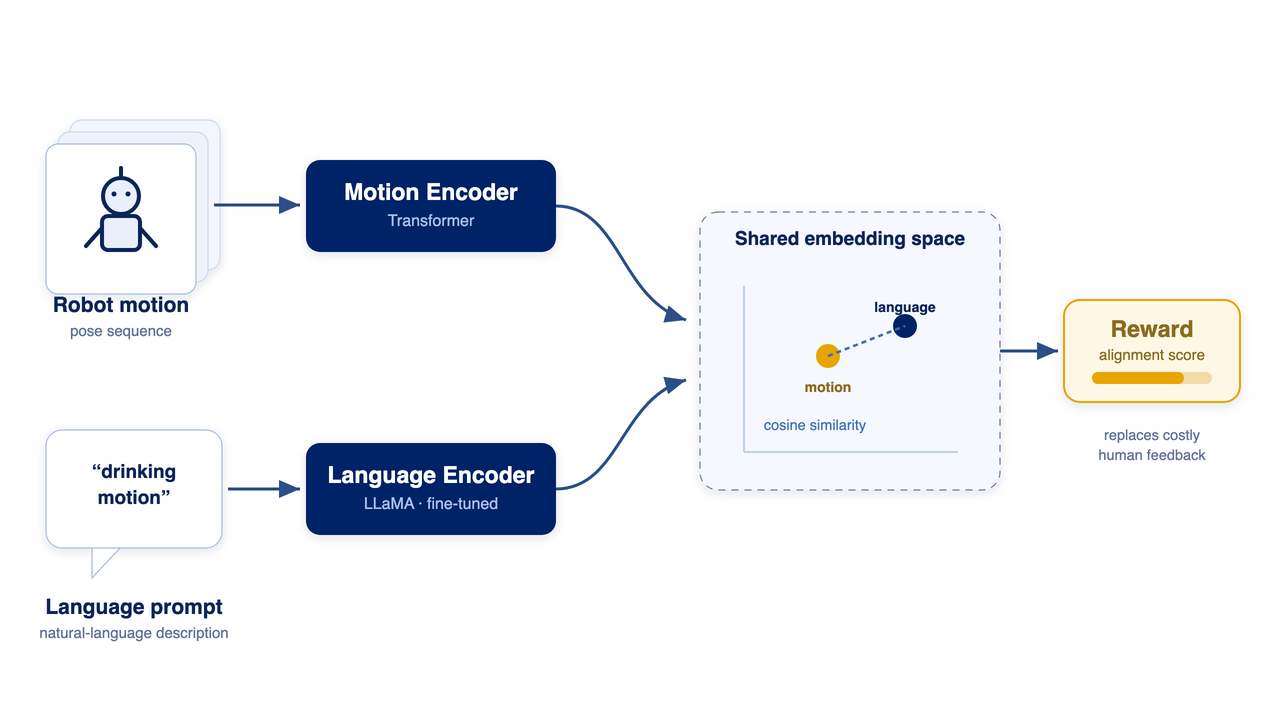
RLHF aligns motion to human intent, but human feedback is slow, costly, and doesn't scale — the bottleneck of my thesis. This prototype swaps the human evaluator for a learned one — RLAIF applied to robotics: a CLIP-style reward model that automatically scores how well a robot's motion matches the semantic intent of a natural-language description ("drinking motion", etc.), pairing a Transformer motion encoder with a fine-tuned LLaMA language encoder in a shared embedding space where cosine similarity becomes the reward. It turns a costly human-feedback reward model into a scalable, automatic one — the direction my thesis itself flagged as its missing piece.
Robot-motion & language embeddings aligned in a shared space to score semantic intent without human labels — replacing the human-feedback reward model in RLHF
Industry Projects
NTS SOLUTIONSLegacy Equipment Video → Structured Manufacturing Data
An end-to-end system that turns legacy-equipment HMI video into structured manufacturing data — with zero hardware modification. A YOLO/Ultralytics detection stack reads on-screen machine state, alarms, and buttons, while a vision-language model (Nanonets-OCR2-3B / Qwen2.5-VL) fine-tuned with 4-bit QLoRA reads lot IDs — lifting exact-match OCR from a 65.5% baseline to 100% on the held-out test set. I shipped it as a compiled, GPU-accelerated GUI app that runs fully on-device. Building the training dataset was a project in itself: dHash diverse-frame selection, targeted cropping, and an AI-assisted review loop that caught and corrected systematic OCR label noise.
Pipeline at a Glance
Detection · YOLO
machine state, alarms & buttons
OCR · VLM
lot IDs — Nanonets-OCR2-3B / Qwen2.5-VL · 4-bit QLoRA
On-device
16 GB VRAM · RTX 5070 Ti vs. DGX Spark (GB10) · no paid APIs
Semiconductor Wafer Defect Detection (AOI)
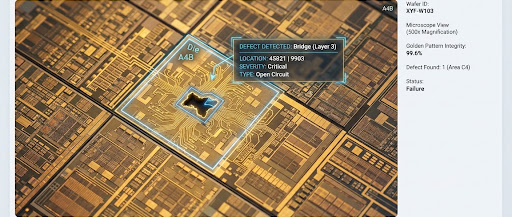
An Automated Optical Inspection (AOI) pipeline for wafer-surface defects across 11 classes, lifting classification accuracy from a 66% baseline to 98.9% — 0% miss, 0.1% overkill — on a held-out evaluation set of ~1,000 images. I benchmarked three detection architectures (YOLOv8s, YOLOv11m, RT-DETR-L) with a custom detection-priority fitness function and per-class threshold optimization, and engineered the data workflow (Pascal-VOC→YOLO, K-fold cross-validation, class-merge/low-sample logic, duplicate/mislabel detection). A deep error investigation — a 10-category false-negative framework, ResNet50 + DBSCAN interclass-similarity clustering, and SAHI tiling — traced the remaining ceiling to labeling quality and localization, not classification.
Experience
Bridging state-of-the-art robotics research and deployed industrial AI systems.
AI Engineer
2025.06 – PresentNTS Solutions
Industrial process automation — computer-vision and VLM systems for semiconductor manufacturing (see Industry Projects above).
AI & Robotics Researcher
2025.04 – 2025.05Designed and built a CLIP-style motion–language reward-model prototype for automatic semantic evaluation of robot motion — a scalable substitute for human feedback in RLHF (see Research above).
AI & Robotics Research Assistant
2022 – 2025Lead researcher on motion retargeting and RLHF-based motion refinement — an IROS 2024 first-author publication and the core of the M.S. thesis.
Academic Foundations
EXCELLENCE RECORDM.S. in Computer Science and Engineering
UNIST (Ulsan National Institute of Science and Technology)
B.S. in Intelligent Mechanical Engineering
Silla University
Awards & Honors
RECOGNITIONGlobal Korea Scholarship (GKS)
NIIED · Ministry of Education, Republic of Korea
Award for Outstanding Academic Achievement
Korean Ministry of Education
Academic Service
COMMUNITY & TEACHINGPeer Reviewer
Reviewed submissions for a top-tier robotics venue.
Student Volunteer
Supported on-site operations at a flagship robotics conference.
Teaching Assistant
UNIST CS courses (Advanced Programming, Principles of Programming Languages, Intro to Algorithms, AI Toolkits), the STAR-MOOC course on Data Representation, and LG Electronics data-analysis training.
Additional Projects
COURSEWORK & UNDERGRAD
Multi-Domain Knowledge Distillation for Robust Human Detection
A multi-teacher, multi-domain knowledge-distillation framework for human detection: three domain specialists — a fine-tuned YOLOv6 (indoor), YOLOv3-pedestrian (outdoor, EuroCity Persons) and Progressive DETR (crowded, CrowdHuman) — distill into a single YOLOv6 student via a novel object-detection distillation loss that pairs response-based classification distillation with a bounded loss for bounding-box regression, lifting mAP from 0.172 to 0.261 on CodaLab.
Hate Speech Detection for Low-Resource Spanish with XLM-RoBERTa-CNN
A hate-speech detection system for Spanish — a low-resource language for this task — pairing the multilingual XLM-RoBERTa transformer with a CNN classification head. Instead of leaning on machine translation to fill the Spanish data gap, the project tests whether natural data from related languages (Spanish, French, Turkish) can carry the task on its own. It can — with enough fine-tuning, pure multilingual data gave the best Spanish results (F1 0.83, recall 0.85 at four epochs), outperforming the translation-based approach, while XLM-RoBERTa-CNN beat a Spanish-specific BETO-CNN on recall. Translation reached strong performance faster, in a single epoch, but it carries the cost of translating the datasets and degraded with longer training as translation bias set in.
Vision-Based Self-Driving Car via Imitation Learning
A self-built robot car that learns to follow a track by behavioral cloning — a CNN maps camera frames to driving actions. Adapted NVIDIA PilotNet to a small (~1,900-frame) self-collected dataset by reframing steering as 3-class classification with a categorical NLL loss, swapping ReLU for PReLU, and using a lighter convolutional stack — raising validation accuracy from 57% to 81% and letting the car drive the track reliably on its own.
Voice-Controlled Robot Car via Amazon Alexa
A first-year embedded-systems team project (as team lead): a robot car driven by spoken commands. Built an end-to-end pipeline — Amazon Echo → Alexa Voice Service → a Node.js skill → PubNub cloud messaging → Raspberry Pi → Arduino → motors — and compared it against a lighter Bluetooth-app control path. Hands-on integration across JavaScript, Python and C++/Arduino, from cloud to hardware.